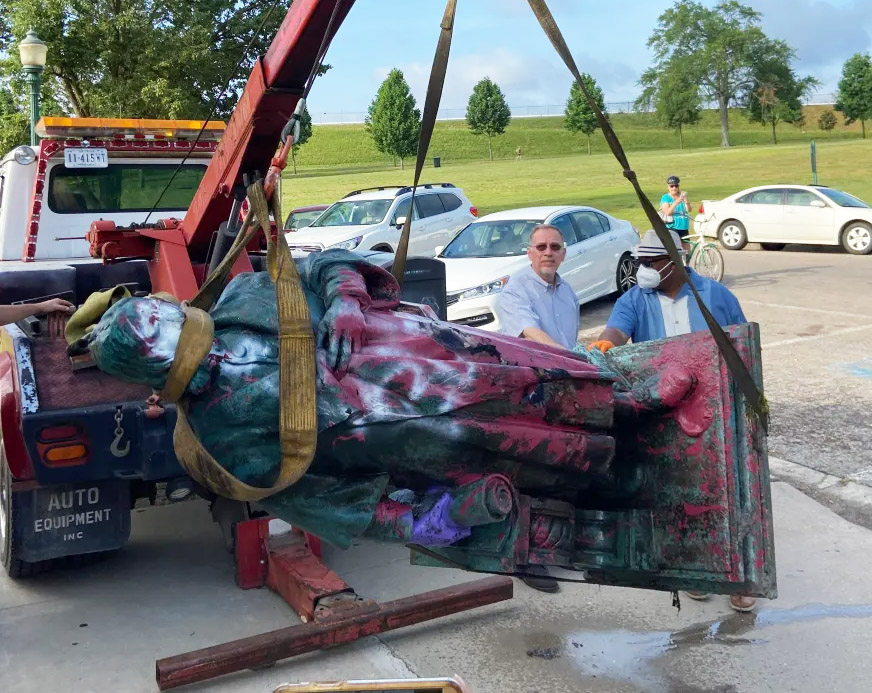
The statue, brought by the Durso Trucking Company, arrives at the Sons of Italy Lodge in Blauvelt, New York. This was the terrible condition of the statue when it was finally removed from its watery grave.
In Richmond, Virginia, the Columbus Monument had been a fixture in the community for nearly a century. In the 1920s, Richmond resident Ferruccio Legnaioli, an artist and sculptor from Florence, Italy, was selected to create the statue. His other work in Richmond through the decades included designing the decorative façade stonework for many of Richmond’s iconic downtown buildings. On December 9, 1927, the Columbus statue was dedicated. The cost to have the statue sculpted, erected and financed entirely by the Italian American community of Richmond and was presented as a gift to the city. It was also the first statue of the Great Navigator to be erected in the South. Few people realize that Italian immigrants began arriving in Richmond in the mid-19th century, forming a small, inclusive enclave within the city. In 1925, the Italian business community organized a fund-raising drive to honor Columbus by erecting a statue as a monument to his world-changing accomplishment. The Admiral of the Seas served as an expression of the cultural identity of both Italians in their adopted country and for Italian Americans, where Columbus symbolized their spirit, history and culture. Located at the entrance to Byrd Park, the monument was viciously and illegally torn down. It was vandalized, set on fire and then thrown into the nearby Swan Lake on the evening of June 9, 2020. This was during one of the nation’s “mostly peaceful protests” that terrorized America during that dreadful summer. In the aftermath of that fateful evening, the Italian American Cultural Association of Virginia (IACA) worked tirelessly in negotiations with the City of Richmond to acquire ownership of the Columbus statue.
At the Sons of Italy Lodge in Blauvelt, New York, are members of the lodge with representatives from the Italian American Cultural Association of Virginia that donated the restored Columbus statue. Pictured are Pat Peterson; Robert Chiapperino; President of the lodge Mike Pizzi; Fred Corritone, Rich Gentile, John Corritone and from Virginia, Frank Papik and Joe Iacometa.
Vandalized, burned and thrown in a pond, the molested statue remained in the water for 2 ½ years.
On December 12, 2022, the Richmond City Council unanimously approved an ordinance transferring ownership of the statue to IACA which took place on February 7, 2023. The restoration of the statue was entrusted to well-known Richmond sculptor, Paul DiPasquale and the first phase of restoring the statue was completed through donations by IACA members. The organization established a Columbus Statue Restoration Fund and donations poured in from the Knights of Columbus Councils throughout the country. In May, the restoration work began. Much of the initial work was sandblasting to remove the graffiti, layers of lead paint and other debris. In the months that followed, the statue was restored and placed on its original bronze base. Readers of the Italian Tribune are well-aware of the importance to keep the legacy of Columbus alive and relevant. So much has happened over the past three decades to discredit the remarkable achievements of the intyrepid explorer. Born in the seafaring Republic of Genoa, the voyages the Great Navigator initiated the gateway to the New World, an accomplishment that had been acknowledged throughout Western Civilization and viewed as one of the most important events of the last millennium. After all of its efforts, the IACA was unable to secure a permanent location for the statue in Richmond. It was then that the Sons of Italy Lodge 2176 of Blauvelt, New York, stepped in and through the generous donations of its members, the Durso Trucking Company was retained to transport the statue from Virginia to the Lodge in Blauvelt. The statue will once again be appreciated as a work of art and will preserve the legacy of “The Great Navigator” for generations to come.