
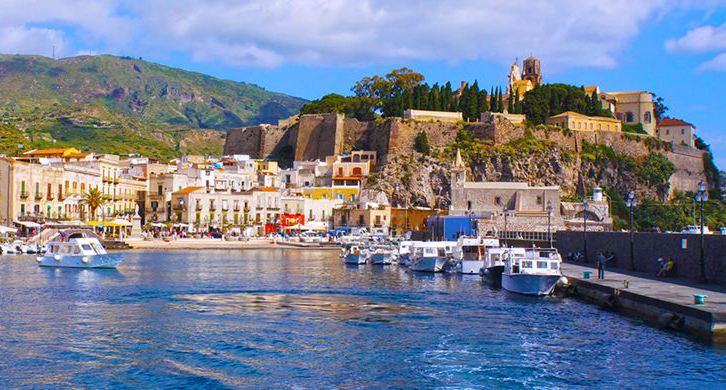

In 2000, Isole Eolie or the Aeolian Islands were inscribed as a UNESCO World Heritage Site. There are two significant reasons, one scientific and the other esthetic. There are seven main islands and several other minor ones, all are volcanic in origin and form an archipelago in the Tyrrhenian Sea north of Sicily. They are situated anywhere from 19 miles to 50 miles off the Sicilian coast, with Vulcano as the closest, Lipari and Salina follow to the north, Filicudi and Alicudi to the west and Panarea and Stromboli to the northeast. The small, uninhabited islands include Basiluzzo, Strombolicchio, Dattilo and Lisca Bianca. While the permanent population is less than 16,000, more than 600,000 visit the islands during summer.
The scientific reasons for including the archipelago are the outstanding records that the islands provide for volcanic island-building and ongoing eruptions. The volcanic phenomena of the islands have been studied since the 18th century and has provided the science of vulcanology with examples of two types of eruptions, Strombolian and Vulcanian. Each type has figured prominently in the education of geologists for more than 200 years and the site continues to enrich the field of vulcanology.
Separated from the Sicilian coast by waters nearly 700 feet deep, these magnificent islands are quite rugged, with deep caverns, steep cliffs and fantastic views. Their rugged beauty provides an important secondary reason for their inclusion as a UNESCO World Heritage Site. While popular as a vacation destination for Italians, far travelers from America have typically made the journey to the islands, but that has been changing in recent years.
Lipari is the largest and some might say, the liveliest of the seven major islands. Like each of the neighboring islands, Lipari has volcanic origins; however, its last significant eruption was recorded in 729 AD and setting foot on the island, it is hard to believe that it is still an active volcano. The town of Lipari is the archipelago’s principal transportation hub, with a small but busy port that leads to pastel-colored houses, picturesque streets and its historic citadel. The castello is entered through its old, defensive gateway and those with an interest in history will want to not only visit the citadel, but also explore its museum housed in several buildings within the castle walls. Away from the town, the island reveals a rugged Mediterranean landscape of low-lying macchia, a dense Mediterranean shrubbery, while among the windswept highlands are precipitous cliffs overlooking deep blue waters.
Salina is the archipelago’s second largest island and boasts a lush, green landscape, thanks to its natural freshwater springs. Woodlands, wildflowers, thick yellow bushes and rows of grape vines are found along its hillsides and like each of the islands of the archipelago, its high coastal cliffs plunge into the breaking waters below. Named for the salt works at the island’s southeastern edge, Salina is shaped by two extinct volcanoes, Monte dei Porri, which rises steeply to 2,840 feet and Monte Fossa delle Felci, which at 3,175 feet is even higher. They are two of the Aeolians’ highest peaks. These mountains form a natural barrier in the center of the island, ensuring that the villages around the perimeter retain their own individual character. Most visitors to the island stay near the main port of Santa Marina Salina, while its other villages provide a sense of serene isolation for those that seek an island paradise.
Panarea is the smallest, but undoubtedly the most fashionable of the Aeolians. During the summer, luxury yachts fill its tiny harbor, while tourists walk the whitewashed streets of San Pietro, its port and principal town. Seemingly in the midst of an endless blue sea, the natural beauty and architectural style of Panarea has been carefully preserved by its residents who number just a few hundred. Cars are prohibited on the island, so bicycles are prominent, but evidence of its ancient residents can be found at the southern tip of the island. There you will find the Bronze Age village of the Milazzese culture that inhabited the site 3,500 years ago. It was just after the Second World War that the remains of 23 huts were excavated, but it is the sparkling Mediterranean that calls visitors to the island. For the adventurous, if you cross the narrow channel from the islet of Bottaro and proceed to Liscia Bianca, you will find the wreck of an old English ship that sank in the 19th century.
The Island of Stromboli is formed by a volcanic cone 3,000 feet above sea level. It is continuously active and pours lava along the northwest coast called Sciara del Fuoco. The other areas of the island are inhabited and covered with vineyards, olive and caper groves. With its ongoing volcanic activity, Stromboli has fascinated geologists for centuries. For the intrepid, climbing the volcano is an unforgettable experience. Access is strictly regulated. You can walk to a height of 1,320 feet, to proceed any higher a guide is required. Periodically, visits to the top are prohibited due to exceptionally active volcanic events. A few years ago this lasted for more than a year. If you want to make the trek, departure is in the afternoon and is timed to reach the 3,000-foot summit at sunset to allow about an hour to observe the crater’s fireworks.
Vulcano, the nearest island to mainland of Sicily is separated from Lipari by a narrow stretch of sea called Bocche di Vulcano. In ancient times, it was thought to be the home of Efesto, the god of fire. Still an active volcano, its last eruption was more than a century ago in 1890. If you have the chance to visit, make sure to visit the island’s beaches. They are located on each side of the isthmus that connects the main island to a smaller one known as Vulcanello. Both beaches are characterized by dark, volcanic sand. While it has provided the origin for the name of all volcanos, it is also famous for its mud baths. It is said to have exceptional beneficial properties, but be prepared for the pervasive smell of sulfur, a reminder of its subterranean activity.
Alicudi is the most western island of the archipelago. The highest peak is that of an extinct volcano. The island offers an extraordinary array of landscapes with beaches, caves and the beautiful sea, rich with fish and lobster and guaranteed to excite visitors with its off-the-beaten-track atmosphere of adventure.
Finally, there is Filicudi, where the pace of change is slow and the island’s tourism infrastructure is modest. Some visitors claim that it is the prettiest in the archipelago and it is certainly the least developed of the inhabited islands. It entices visitors with its rugged coastline lapped by crystal clear waters and pitted by deep grottoes. The island has just a few small villages, but that should not stop you. By all means, when you plan your next trip to Sicily make sure to include a visit to the Aeolian Islands, where science and beauty combine to make this one of the most unique places in the world.